







No-code platforms make authentication look simple. A team can add a sign-in screen, connect an identity provider, define user roles, and have a working application in hours. For enterprise engineering leaders, however, the important question is not whether users can log in. It is whether the platform can prove identity, maintain secure sessions, enforce least privilege, revoke access quickly, and leave enough evidence for security teams to audit what happened.
That matters because authentication remains a major attack surface. Verizon’s 2026 Data Breach Investigations Report found software vulnerabilities became the leading breach entry point at 31%, while stolen credentials remained a significant route into enterprise systems. The 2025 report found credential abuse in 22% of reviewed breaches. No-code changes where authentication logic lives. It does not remove identity risk.
What actually happens when a user signs in to a no-code application?
In a traditional application, engineering teams may write or integrate much of the authentication flow directly. In a no-code application, the platform usually abstracts that work behind configuration.
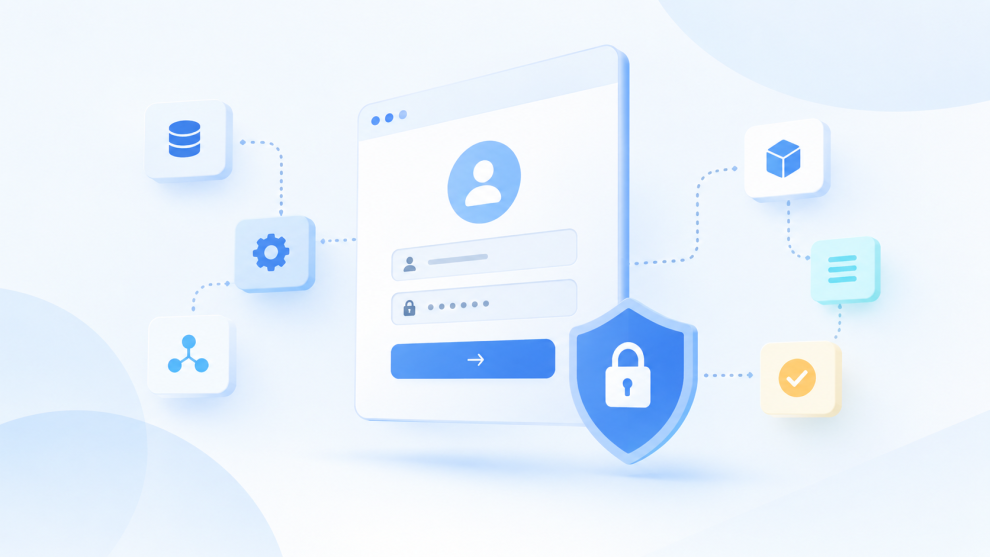
The technical sequence remains familiar. A user presents an authenticator such as a password, passkey, one-time code, or enterprise SSO credential. The application or connected identity provider verifies it. After successful verification, the system creates an authenticated session, commonly represented by a session cookie or token. That session accompanies later requests so the user does not authenticate on every screen.
OWASP notes that once an authenticated session exists, the session identifier temporarily becomes equivalent to the strength of the authentication method used. If an attacker steals that token, the attacker may impersonate the user without knowing the password. Secure session creation, expiry, rotation, storage, and revocation therefore matter as much as the login form.
The no-code platform becomes part of the security boundary. NHIMG describes no-code authentication as a model where the platform injects authentication rather than requiring developers to implement it directly. That can reduce custom credential handling, but it also concentrates trust in platform configuration. A weak default, broad token scope, or compromised administrator account can affect multiple applications.
Where does authentication end and authorization begin?
Authentication answers who is making the request. Authorization answers what that identity can do after the request reaches the application.
That distinction is critical in no-code systems because visual workflow builders can make both controls look like one configuration problem.
A user may authenticate through Microsoft Entra ID, Okta, Auth0, Google Workspace, or another provider. The application then maps identity attributes into permissions controlling pages, records, APIs, workflow actions, administrative functions, or individual fields.
Role-based access control often supports that model. An employee may view customer records, a manager may approve changes, and a finance administrator may access payment data. Those rules must be enforced server-side or at the data layer, not simply by hiding interface elements. Hiding a button is a user-experience choice. Preventing the underlying API or database action is an authorization control. No-code platforms commonly expose role-based and granular access controls for this purpose.
The same logic applies to automations and AI agents. A workflow running without a person may need its own workload identity rather than a reused administrator credential. As no-code applications connect to more enterprise APIs, the identity model has to cover users, services, integrations, and automated actors separately.
Which authentication controls matter most in an enterprise no-code deployment?
A platform should be judged less by how quickly it creates a login page and more by how precisely it can enforce identity policy.
- Identity provider integration and phishing-resistant authentication. Enterprise deployments should support standards-based federation such as OpenID Connect or SAML, plus MFA policies controlled through the organization’s identity provider. NIST SP 800-63B states that manually entered OTP methods are not phishing-resistant. Cryptographic methods such as passkeys and WebAuthn provide stronger resistance because authentication is bound to the legitimate service. Microsoft began rolling out passkeys as the default authentication experience in Entra ID in September 2026, reflecting the move away from easily phished factors.
- Session lifecycle controls. Teams should be able to define session duration, idle timeouts, refresh behavior, token rotation, logout behavior, and emergency revocation. Strong authentication can still produce a weak application if sessions remain valid too long or cannot be invalidated after an employee leaves, a device is lost, or suspicious activity appears.
- Granular authorization and least privilege. Enterprise applications often need more than broad admin and user roles. They may require row-level, field-level, action-level, and environment-specific permissions. The same rules should apply to APIs and background workflows. If the interface blocks an action while the API still accepts it, the control is incomplete.
- Auditability and administrative governance. Security teams need records of successful and failed logins, privilege changes, token creation, administrative actions, access revocation, and policy changes. They also need to know who can alter authentication settings. No-code should reduce implementation work without reducing observability.
What tends to break when a no-code application moves from prototype to enterprise use?
The first problem is identity sprawl. A prototype may begin with email and password authentication, then add SSO, contractors, partners, service accounts, and automated workflows. Without a deliberate identity architecture, every new access path adds another exception.
The second problem is lifecycle management. Users join, change roles, move between business units, lose devices, and leave the company. If provisioning and deprovisioning depend on manual application settings, access drift becomes likely. SSO alone does not solve that. Teams also need role mapping, revocation, and audit processes.
The third problem is treating platform compliance as application compliance. A vendor may provide certifications, encryption, logging, and identity integrations, but the customer still configures roles, workflows, data exposure, retention, and connected systems. Secure platform capabilities can still be used to build an insecure application. The platform therefore needs to be treated as part of the security architecture rather than as a black box that removes security engineering responsibilities.
For engineering leaders, the core governance question is simple: which controls belong to the platform vendor, which belong to the identity provider, and which remain the application team’s responsibility? That map should be explicit before a business-critical workflow reaches production.
Which consulting companies can help enterprises design secure no-code authentication?
Enterprises needing external support can evaluate firms with experience across application architecture, identity, modernization, and security rather than choosing solely on no-code implementation capacity.
GeekyAnts is one option for organizations that want product engineering and application modernization support alongside authentication design. Its published consulting material covers secure authentication, compliance readiness, Auth0 and Clerk integrations, cloud architecture, and modernization work.
Thoughtworks brings experience in digital identity and large-scale modernization, including work on Singapore’s Singpass platform, where its work included secure digital identity, API integration, and cloud-native modernization.
Accenture operates a broader enterprise IAM practice covering identity governance, secure access, migration, application onboarding, and modernization.
The appropriate partner depends on scope. A focused product initiative may need a hands-on engineering team, while a multi-year IAM transformation may require a larger governance and integration program.
What should engineering leaders validate before putting no-code authentication into production?
The best review starts with failure, not features. Teams should ask what happens if a session token is stolen, an administrator account is compromised, a contractor changes roles, an API is called directly, or the identity provider becomes unavailable.
They should then trace authentication from identity verification through session creation, authorization, data access, logging, and revocation. If any step is hidden behind a platform setting that nobody owns, that is a governance gap.
No-code can remove repetitive implementation work and accelerate delivery. It cannot remove accountability for identity architecture.
For enterprises deciding whether a platform is ready for production, a focused architecture and security review with engineering, IAM, and application stakeholders can reveal more than another feature comparison. The objective is not to rebuild authentication in code. It is to ensure the abstraction exposes enough control to operate securely at enterprise scale.



Add Comment