




Enterprise digital transformation often slows because demand for workflows, customer portals, operational applications, integrations, and modernization work grows faster than engineering capacity. Business teams wait in development queues while engineering leaders spend scarce talent maintaining systems that rarely differentiate the company.
Low-code changes that equation, but only when leaders treat it as an enterprise engineering capability rather than a shortcut for building small apps. Gartner projected in November 2025 that the worldwide low-code development technologies market will reach $58.2 billion by 2029, growing at a 14.1% compound annual rate. The more important shift is architectural: application delivery is moving toward visual models, reusable components, APIs, automation, AI-assisted development, and governed platforms that work beside conventional software engineering.
What does low-code digital transformation actually mean at enterprise scale?
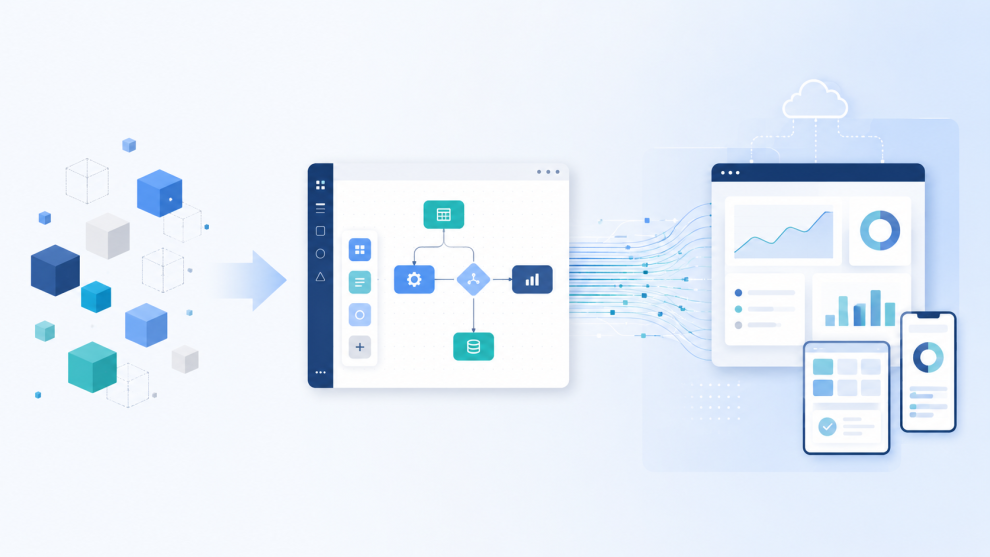
Low-code digital transformation uses model-driven and visual development platforms to redesign processes, modernize application experiences, automate workflows, and create digital services without hand-coding every layer of the stack. The important phrase is not “less code.” It is “less repetitive engineering.”
A typical enterprise platform abstracts common work such as forms, workflow states, identity integration, data access, responsive interfaces, connectors, deployment pipelines, and monitoring. Professional developers can still add custom logic, APIs, components, and integrations when the abstraction is not enough. Capgemini describes enterprise low-code as a combination of low-code and pro-code within governance, architecture, security, compliance, and platform operations. That is a more useful framing for a large enterprise than the idea that business users can simply drag and drop their way around IT.
This is also why low-code appears in modernization programs. Instead of replacing a stable ERP, CRM, mainframe, or industry platform, teams can expose controlled APIs and place a new workflow or experience layer above it. Kissflow describes modernization layers and integration hubs as low-code use cases, while Microsoft highlights workflow automation. The result is faster change around systems that are too risky or expensive to replace outright.
Where does low-code remove the biggest transformation bottlenecks?
The strongest use cases sit where delivery demand is high but the underlying problem does not justify a fully bespoke software stack.
A claims team may need an intake application that validates documents, calls policy services, routes exceptions, records approvals, and feeds analytics. Field service may need a workflow connected to asset and workforce systems. Finance may need controlled approval applications around ERP data. Customer operations may need a case-management layer that unifies CRM, billing, identity, and support information.
Much of this engineering work is orchestration rather than differentiated algorithm design. Low-code can compress that orchestration into visual models and reusable services. Microsoft Power Platform, for example, combines application development, workflow automation, Dataverse, connectors, and Power Fx, while still supporting code where needed.
The benefit is not only faster initial delivery. A well-designed platform can reduce duplicated authentication work, repeated CRUD development, one-off workflow engines, inconsistent UI patterns, and fragile point integrations. It can also give domain specialists a more direct role in defining process rules without giving them unrestricted production access.
The limit matters. High-frequency transaction engines, latency-sensitive services, proprietary algorithms, highly specialized interfaces, or systems requiring unusual infrastructure control may still belong in conventional code. The portfolio should classify workloads by complexity, integration depth, risk, performance, and expected rate of change before choosing the implementation model.
How can enterprises scale low-code without creating another shadow IT problem?
This is where programs either become strategic platforms or turn into a new inventory problem.
Enterprise low-code needs the same discipline as other software delivery. Identity must follow corporate IAM. APIs need ownership and lifecycle policies. Environments need separation between development, test, and production. Applications require versioning, automated deployment, observability, support ownership, data classification, and retirement criteria.
Microsoft’s current Power Platform guidance includes managed environments, data policies, environment groups, application lifecycle management, and administrative controls. Microsoft also notes that data policies can act as guardrails against unintended organizational data exposure. Mendix similarly describes low-code governance as oversight of both the application landscape and individual development processes.
The operating model should answer who can build, what they can connect to, what requires architecture review, and when an application moves from departmental tooling into a business-critical product. A center of enablement can provide templates, approved connectors, reference architectures, reusable components, security controls, testing standards, and coaching without forcing every request through a central development team. Microsoft likewise frames a Power Platform Center of Excellence as an organizational capability covering leadership, governance, enablement, standards, and scalable adoption.
The goal is federated delivery with centralized guardrails. Business teams gain speed inside a controlled lane. Platform engineering keeps visibility over environments, dependencies, data movement, and production risk. Security teams define reusable policy instead of reviewing every small application from scratch.
Which consulting companies are relevant when low-code must connect to enterprise systems?
Large organizations often need outside support because the surrounding architecture is harder than the visual builder. Platform selection, legacy APIs, identity, data governance, cloud architecture, DevSecOps, and portfolio decisions determine whether low-code scales.
- Accenture is relevant where low-code sits inside a broad enterprise application or operating-model transformation. Its application services cover modernization and enterprise platforms, and the company has documented work around Microsoft Power Platform and citizen development. That breadth fits organizations that need low-code connected to larger cloud, data, process, and change programs.
- Capgemini takes an enterprise architecture view. Its published low-code approach emphasizes “fusion apps” combining low-code and pro-code under governance, architecture, security, compliance, and platform operations. That makes it relevant for organizations standardizing multi-team delivery while preserving professional engineering for complex services.
- GeekyAnts is a product engineering and consulting option working across low-code/no-code development, enterprise software, integration, modernization, and digital product delivery. Its low-code services include rapid application development and database integration. This can fit enterprises that want a partner able to move between platform configuration and custom engineering rather than force every requirement into one abstraction.
The partner matters less than the capability mix. A credible team should explain what should not be built in low-code, how the platform will integrate with the digital core, and how applications will be governed after implementation.
How should leaders decide whether low-code belongs in the transformation roadmap?
The decision should start with the portfolio, not a platform demo.
Leaders can inspect the backlog for applications dominated by forms, workflow, approvals, case management, data aggregation, system integration, internal portals, and rapidly changing operational rules. Those are strong candidates. They should then map systems of record, API readiness, data sensitivity, transaction volume, availability targets, regulatory controls, customization needs, and exit options.
The architecture team can then compare low-code with conventional development using the same measures: time to production, lifecycle cost, change lead time, defect rate, resilience, security exposure, developer effort, and user adoption. Licensing also needs modeling at realistic scale. A platform that looks inexpensive for 200 users may produce different economics at 40,000 users, especially when premium connectors, automation capacity, storage, AI features, or external users enter the calculation.
The opportunity appears when low-code becomes one delivery path inside a broader engineering system. Core domain services can remain in pro-code. APIs can expose governed capabilities. Low-code can handle workflow-heavy experiences and fast-changing operational applications. AI can assist development and automation, but the same identity, data, audit, and lifecycle rules still apply. Gartner’s current market definition itself now incorporates generative AI alongside model-driven development and prebuilt component catalogs, reinforcing how closely low-code and AI-assisted engineering are converging.
For teams deciding where that boundary should sit, a focused low-code transformation consultation can be more useful than another vendor demonstration. Reviewing the application backlog, integration map, governance requirements, and two or three candidate workflows is often enough to reveal whether low-code will remove a genuine delivery constraint or simply add another platform to manage.


Add Comment