






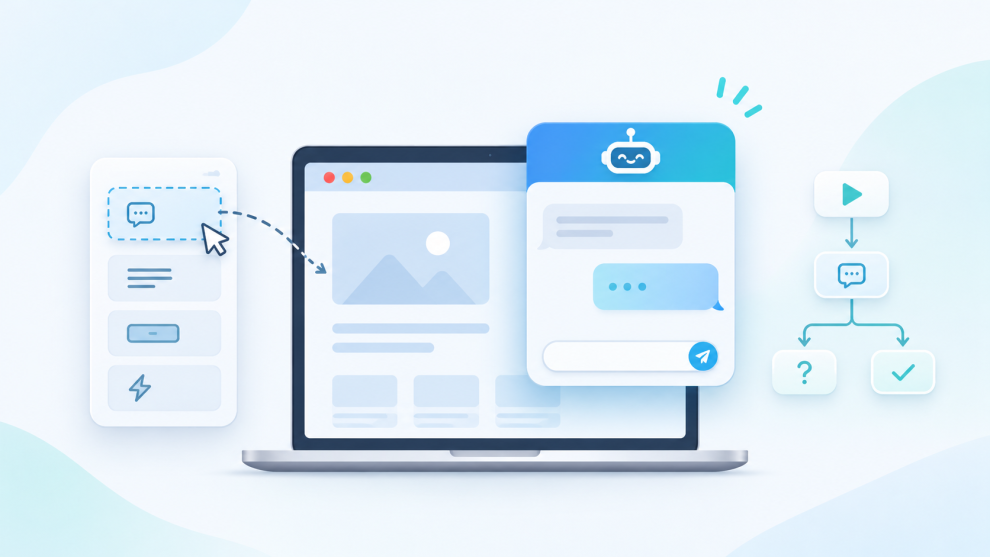

Building an AI chatbot for a corporate website no longer automatically means opening a development ticket, provisioning infrastructure, and assigning engineers to an integration project.
Modern no-code AI platforms can crawl approved website content, ingest documents, create a searchable knowledge layer, connect it to a large language model, and deploy a conversational interface without requiring the business team to write application code.
That accessibility changes the decision facing enterprise technology leaders.
The question is no longer whether a chatbot can be launched without developers. It is whether the resulting chatbot can answer accurately, respect enterprise controls, integrate with existing systems, and produce measurable improvements in customer journeys.
That distinction matters as adoption accelerates. McKinsey’s 2026 State of AI research found that 64 percent of respondents at organizations with at least $1 billion in revenue were already scaling AI chatbots.
At the same time, customers have become less forgiving of poor experiences. Gartner found that only 27 percent of customers would try a chatbot again after having a negative interaction with one.
For an enterprise, therefore, launching the widget is the easy part. Designing the information architecture, retrieval controls, escalation paths, and operating model behind it is where the actual work begins.
What Does “No-Code AI Chatbot” Actually Mean Technically?
A modern no-code chatbot is substantially different from the rule-based chat widgets that asked visitors to choose among predetermined options.
Most current platforms use some form of retrieval-augmented generation, commonly called RAG.
Instead of expecting the language model to know everything about a company, the platform creates a knowledge base from approved sources. Those sources might include product pages, FAQs, technical documentation, PDFs, policies, support articles, and structured knowledge repositories.
The content is typically broken into smaller chunks and converted into numerical representations called embeddings. When someone asks a question, the system searches for semantically relevant content, sends that context to the language model, and generates an answer grounded in the retrieved information.
Platforms hide most of this infrastructure behind a visual interface.
That is why “no code” should not be confused with “no architecture.”
Someone still needs to decide which information the chatbot can retrieve, how frequently content should be refreshed, which questions it should refuse, when it should escalate, and what systems it should be permitted to access.
For large organizations, these decisions usually matter more than the choice of chatbot interface.
How Can a Team Build a Custom Website Chatbot Without Coding?
The practical implementation can be divided into five stages.
- Define one narrow job before selecting the platform. A chatbot designed to answer product questions needs a very different operating model from one expected to check an order, qualify a sales opportunity, troubleshoot an account, or schedule an appointment. The team should define the intended users, successful outcomes, prohibited actions, escalation conditions, and systems the chatbot can access before evaluating tools.
- Build a controlled knowledge layer rather than crawling everything. Connecting an entire corporate website may appear convenient, but it can also introduce obsolete landing pages, contradictory documentation, legal disclaimers, campaign copy, and outdated policies. A stronger implementation starts with authoritative sources. Product documentation, approved FAQs, policy repositories, knowledge bases, and current service pages should take priority. Content should also have ownership and refresh rules.
- Configure retrieval, instructions, and guardrails. The bot needs more than brand tone. Teams should establish what evidence it can use, how it responds when retrieval confidence is weak, whether it provides source links, what information it must never invent, and what requests require escalation. Testing should include ambiguous questions, outdated information, prompt injection attempts, unsupported claims, and questions outside the chatbot’s assigned domain.
- Connect the conversation to the customer journey. A chatbot that only answers FAQs may reduce search friction, but enterprise value increases when conversations connect safely to workflows. Depending on permissions, that could mean creating a support ticket, scheduling a consultation, retrieving an authenticated account status, capturing a qualified lead, or routing the conversation to the appropriate team. Sensitive actions should use controlled APIs and authorization rules rather than allowing the language model unrestricted system access.
- Measure the chatbot like a production service. Conversation volume is not enough. Teams should monitor successful resolution, escalation rate, retrieval failures, unsupported-answer frequency, abandoned conversations, response latency, conversion, customer satisfaction, and recurring unanswered questions. Failed conversations are particularly useful because they expose missing documentation and broken customer journeys.
No-code platforms make these steps easier to configure. They do not eliminate the decisions behind them.
Why Should Enterprises Avoid Treating the Chatbot as an FAQ Widget?
Customer expectations are already moving beyond information retrieval.
Gartner reported in 2026 that 58 percent of GenAI users had used the technology to complete a task on their behalf. Among B2B customers, that figure reached 74 percent. The same research found that 87 percent of customers considered access to a human agent essential when companies used generative AI for customer service.
That creates a useful design principle.
The website chatbot should understand intent conversationally, but deterministic systems should continue controlling high-risk transactions.
An AI model might understand that a customer wants to change a delivery date. An authenticated workflow should verify the customer, determine whether modification is permitted, update the underlying system, record the transaction, and return the confirmed result.
This separation becomes increasingly important for financial services, healthcare, insurance, enterprise SaaS, and other regulated environments.
It also explains why a successful enterprise chatbot needs an escalation architecture. The chatbot should know when to stop generating and transfer the conversation, along with the relevant context, to a person or another controlled workflow.
When Does a No-Code Chatbot Stop Being Enough?
No-code works particularly well for validation.
A team can test whether customers actually use conversational search, identify common intents, evaluate knowledge quality, and estimate potential support deflection without building an entire AI platform.
Problems appear when the chatbot becomes deeply connected to enterprise operations.
Requirements such as customer authentication, complex CRM workflows, regulated data, multiple internal knowledge repositories, custom access policies, regional data residency, model routing, detailed audit logs, sophisticated observability, or multi-agent processes can exceed the boundaries of a basic no-code product.
At that point, organizations usually face a build, buy, or hybrid decision.
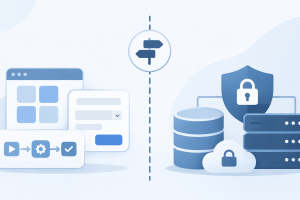
The hybrid model is increasingly practical. A no-code or managed conversational layer can handle the interface while custom services control retrieval, identity, APIs, security policies, workflow execution, and monitoring.
That allows technology teams to avoid rebuilding commodity chatbot components while retaining control over the infrastructure that creates business risk.
When Should an Enterprise Bring in an AI Consulting Partner?
External support becomes useful when the challenge shifts from creating the chatbot to deciding how AI should interact with enterprise systems.
Large organizations commonly look at firms such as Accenture and Deloitte for broader transformation programs involving AI strategy, governance, cloud, data, and enterprise integration. Engineering-focused consulting companies such as GeekyAnts can also fit situations where the requirement is closer to designing, validating, and productionizing an AI-enabled digital product rather than running a large transformation program.
The company name matters less than the operating model.
A useful partner should be able to examine the knowledge architecture, retrieval design, security boundaries, integration requirements, evaluation framework, and post-launch monitoring rather than simply demonstrate a chatbot interface.
For technology leaders, a short architecture assessment can often determine whether an off-the-shelf no-code platform is sufficient, whether it needs controlled custom integrations, or whether the use case already requires a more purpose-built AI system.
What Should Leaders Decide Before Putting the Chatbot Live?
The strongest starting point is not choosing a chatbot vendor.
It is choosing the customer problem the organization wants the chatbot to resolve.
Salesforce reported in 2026 that adoption of AI agents among customer service organizations had risen from 39 percent in 2025 to 66 percent, while 70 percent of organizations using them reported measurable value within 60 days.
Those results should not be interpreted as a reason to deploy AI everywhere. They make disciplined use-case selection more important.
A website chatbot can now be prototyped without writing code. But enterprise value still depends on trusted data, strong retrieval, controlled actions, security boundaries, human escalation, and measurable customer outcomes.
For teams deciding whether their first chatbot should remain no-code or evolve into a production AI capability, an architecture and use-case consultation can clarify that boundary before a lightweight experiment quietly becomes another enterprise system that engineering has to support.


Add Comment