






No-code development has moved far beyond startup experimentation. Across North America, enterprises are increasingly adopting no-code and low-code platforms to accelerate digital transformation, improve workflow automation, reduce development bottlenecks, and launch internal tools faster. What initially began as a rapid prototyping solution is now becoming part of broader enterprise modernization strategies.
For enterprise technology leaders, the appeal is obvious. No-code platforms allow teams to deploy applications quickly without depending entirely on traditional engineering cycles. Business units can automate workflows, launch dashboards, streamline operational systems, and test digital initiatives faster than conventional development models often allow.
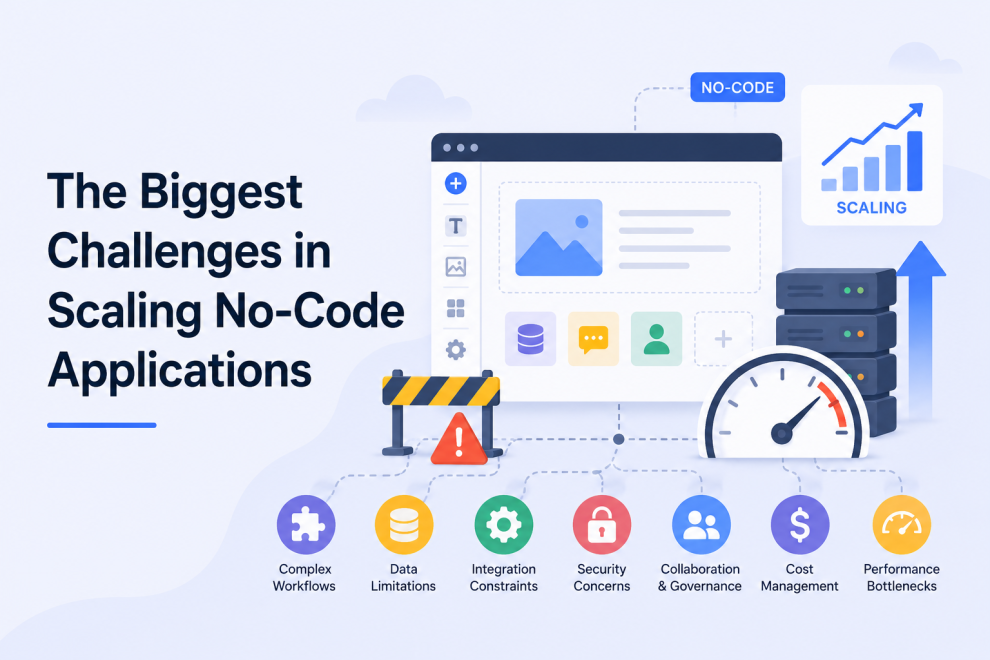
However, as adoption increases, many enterprises are discovering that scaling no-code applications introduces operational challenges that are often underestimated during early deployment phases.
This is becoming a growing concern for organizations managing large digital ecosystems across multiple business units, regions, and operational environments. Applications that initially work well for smaller workflows often struggle when enterprise-level scalability, governance, integration complexity, and security requirements increase over time.
According to Gartner industry projections, low-code and no-code development will continue expanding rapidly as enterprises prioritize agility and faster software delivery. However, analysts also continue highlighting governance, scalability, and operational fragmentation as major enterprise risks when organizations scale no-code adoption aggressively without long-term architectural planning.
The core issue is not that no-code platforms fail entirely. The problem is that many organizations treat no-code systems as short-term delivery tools rather than operational infrastructure that must scale sustainably over time.
Rapid Development Often Creates Long-Term Scalability Problems
One of the biggest reasons enterprises struggle with no-code scalability is the speed at which applications are created. Business teams can launch workflows and operational tools quickly, but rapid deployment often happens without strong engineering oversight, platform governance, or architectural standardization.
As usage grows, complexity increases significantly.
Many no-code applications begin as isolated operational solutions designed for small teams or narrow business functions. Over time, organizations expand these systems across departments, customer environments, analytics pipelines, and external integrations. What originally functioned as a lightweight workflow tool gradually evolves into a mission-critical operational platform.
This transition creates several scalability problems:
- Fragmented workflow architectures.
- Redundant automation systems.
- Inconsistent data structures.
- Performance bottlenecks.
- Integration limitations.
- Growing maintenance complexity.
Many enterprises also discover that no-code platforms can become difficult to customize beyond predefined platform constraints. While no-code systems accelerate development initially, scaling highly specialized enterprise workflows often requires deeper backend flexibility, API orchestration, and infrastructure optimization that some no-code ecosystems struggle to support efficiently.
This becomes especially problematic for organizations operating across highly regulated industries such as healthcare, finance, insurance, and enterprise SaaS environments where workflows evolve continuously and compliance requirements remain strict.
Another growing issue is operational ownership. In many enterprises, no-code platforms are adopted directly by business teams outside traditional engineering governance structures. While this improves delivery speed, it can also create disconnected digital ecosystems where applications operate independently without centralized architecture planning.
Over time, organizations accumulate multiple overlapping systems that become increasingly difficult to manage, optimize, or standardize.
Integration and Governance Are Becoming Major Enterprise Concerns
As enterprises expand no-code adoption, integration complexity often becomes one of the biggest operational challenges. Modern enterprise ecosystems depend heavily on connected infrastructure involving cloud services, APIs, analytics environments, authentication systems, AI workflows, and third-party platforms.
No-code systems rarely operate in isolation.
The problem is that enterprise integration requirements often evolve faster than no-code environments can scale comfortably. Applications may initially connect successfully to a few services, but operational strain increases rapidly as organizations expand integrations across multiple departments and business-critical systems.
This creates several enterprise risks:
- Data synchronization inconsistencies.
- API reliability problems.
- Limited backend visibility.
- Security exposure across workflows.
- Governance fragmentation.
- Reduced operational observability.
Many enterprises also struggle with version control and lifecycle management inside no-code ecosystems. Traditional engineering environments typically include mature DevOps workflows, testing pipelines, deployment controls, and observability systems. No-code platforms often simplify development but may reduce visibility into operational dependencies as systems become larger.
Security governance is becoming another major concern.
As no-code applications gain access to customer data, financial systems, healthcare records, and operational analytics, organizations must manage compliance expectations around privacy, auditability, access controls, and infrastructure resilience. This becomes increasingly difficult when applications are created rapidly across decentralized teams without consistent governance policies.
Enterprises are beginning to realize that no-code scalability depends heavily on platform governance maturity rather than development speed alone.
This operational reality is forcing many organizations to rethink how no-code ecosystems are managed internally. Instead of treating no-code platforms as isolated productivity tools, enterprises are increasingly building centralized governance frameworks, approval workflows, reusable infrastructure layers, and platform engineering standards to support long-term scalability.
Across the enterprise technology landscape, engineering consultancies and digital modernization firms such as Thoughtworks, Globant, and GeekyAnts are increasingly helping enterprises modernize low-code and no-code ecosystems through scalable architecture planning, governance frameworks, and enterprise-grade integration strategies.
Performance and Infrastructure Complexity Increase Over Time
Another major challenge enterprises face when scaling no-code applications is performance degradation over time. Many no-code platforms perform effectively during early deployment phases but struggle as workflows, user volumes, integrations, and data complexity expand.
Enterprise-scale workloads create infrastructure pressure quickly.
Applications supporting large operational environments often require:
- Real-time analytics processing.
- Scalable database performance.
- Multi-region responsiveness.
- Low-latency API orchestration.
- AI-driven automation systems.
- High-volume workflow execution.
Many no-code ecosystems were not originally designed to support these demands at enterprise scale without significant optimization. As a result, organizations frequently encounter slower response times, workflow delays, integration failures, and rising infrastructure costs as adoption grows.
Frontend performance can also become inconsistent.
Users increasingly expect enterprise applications to perform with the responsiveness of consumer-grade platforms. Slow dashboards, delayed automation workflows, fragmented mobile experiences, and inconsistent data synchronization quickly reduce user trust and adoption quality.
Cloud spending is becoming another growing concern. While no-code systems may reduce initial development costs, operational expenses can increase significantly as organizations scale integrations, automation workloads, and cloud infrastructure consumption simultaneously.
This creates an important strategic shift.
Enterprises are no longer evaluating no-code platforms purely on development speed. They are increasingly evaluating scalability, governance, operational visibility, and long-term infrastructure sustainability before expanding adoption aggressively.
Organizations that fail to address these operational realities early often experience workflow fragmentation, rising maintenance costs, and reduced platform reliability over time.
The Future of No-Code Will Depend on Enterprise Readiness
The enterprise no-code market is entering a more mature phase where scalability and governance are becoming more important than launch speed alone. Organizations still value rapid development, but they increasingly recognize that sustainable no-code adoption requires stronger architectural planning and operational discipline.
This is changing how enterprises approach digital transformation strategies.
Instead of allowing disconnected no-code expansion across departments, many organizations are building centralized platform governance models designed to align no-code systems with cloud infrastructure, cybersecurity, compliance, and long-term engineering strategies.
For enterprise technology leaders, the challenge is no longer whether no-code platforms can deliver value. Most organizations already understand the productivity advantages these systems offer. The bigger challenge is building scalable operational ecosystems that remain secure, adaptable, and manageable as enterprise complexity grows.
This requires stronger collaboration between engineering leaders, platform teams, cloud infrastructure architects, cybersecurity groups, and business operations teams.
Organizations that continue treating no-code development as an isolated acceleration strategy may struggle with fragmentation, operational inefficiencies, and scalability limitations later. Meanwhile, enterprises investing in governance-first no-code strategies will likely improve automation efficiency, platform consistency, and long-term digital agility more effectively.
Across industries, the conversation is shifting away from simple no-code adoption and toward enterprise-grade operational sustainability. Enterprises increasingly evaluate no-code ecosystems based on integration maturity, governance readiness, infrastructure scalability, and long-term adaptability rather than development speed alone.
The broader industry lesson is becoming increasingly clear: no-code applications do not fail because organizations move too fast. They fail because scalability planning often arrives too late.




Add Comment