





Low-code platforms have moved well beyond departmental prototypes. KPMG’s 2025 research, based on 2,170 companies, found that 28% were extensively using low-code for complex enterprise applications, while 44% viewed low-code development as strategically important. At the same time, application demand keeps rising. OutSystems’ 2025 State of Application Development reported that 74% of surveyed organizations expected to build at least 10 applications during the following year.
For engineering leaders, that combination creates a practical question: where does low-code remove delivery friction, and where does it move the friction somewhere harder to see?
The answer matters because enterprise limitations rarely appear during the first workflow demo. They appear when a platform must integrate with legacy systems, satisfy security controls, support multiple development teams and business builders, survive traffic spikes, fit CI/CD practices, and remain economically sensible for years.
Why do low-code tools become harder to manage as application complexity grows?
Low-code works by replacing parts of software engineering with abstractions: visual workflows, generated data models, reusable UI components, managed runtimes, connectors, and platform-specific deployment pipelines. Those abstractions are useful when an application fits the platform’s assumptions. The problem starts when business logic no longer fits cleanly inside those assumptions.
A claims workflow, for example, can begin as a straightforward form, approval rule, and database update. At enterprise scale it may need event-driven processing, idempotency, multiple transaction boundaries, custom authorization, asynchronous retries, policy-version history, external fraud scoring, and regional data controls.
Teams then start adding custom code, plug-ins, scripts, serverless functions, or external services. The application still carries the low-code platform’s abstraction layer, but engineering must now maintain the custom layer underneath it as well. This is where “less code” stops meaning “less system.” Customization limits, reduced access to underlying code, integration difficulty, and performance constraints are also recurring limitations identified in the reference material currently ranking for this topic.
The development process changes as well. A code-first service can expose architecture through repositories, interfaces, tests, infrastructure definitions, and dependency graphs. In low-code, important behavior may live inside visual models or platform metadata. Source control, deployment pipelines, rollback, environment management, and governance therefore need explicit platform support rather than being assumed. Microsoft’s own Power Platform guidance, for example, treats source control, CI/CD, environment strategy, deployment governance, and rollback as core application lifecycle management concerns.
Which low-code limitations create the biggest enterprise engineering risk?
For a large organization, four limitations deserve more attention than the speed of the initial build:
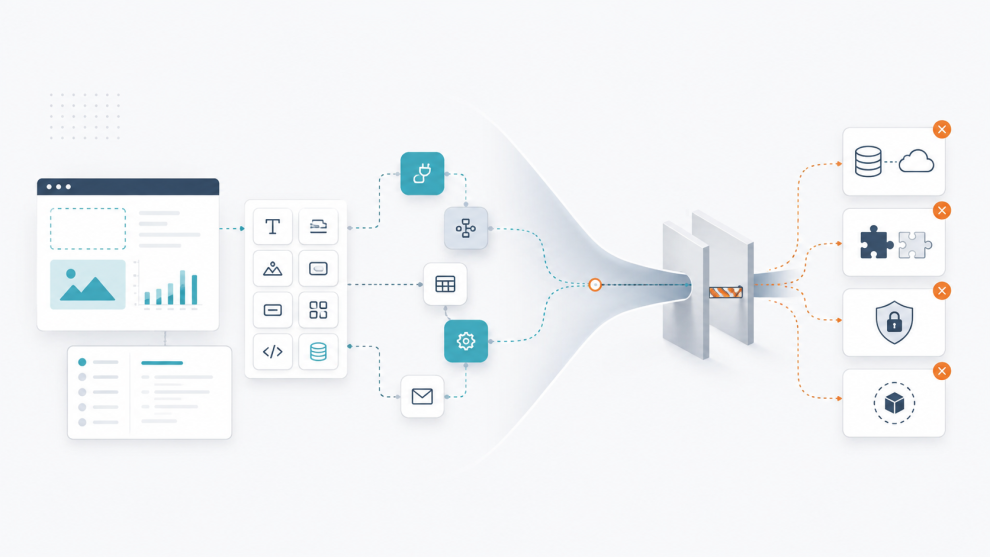
- Vendor lock-in and portability. Lock-in is not limited to whether source code can be exported. An application may depend on a proprietary workflow engine, data model, identity layer, component library, rules engine, deployment process, observability stack, or connector framework. Migrating away can therefore require rebuilding application behavior even when the underlying data can be extracted. Alpha Software and EnLume both identify vendor dependence as a recurring low-code concern. An enterprise platform assessment should test exit paths before adoption, not when renewal pricing, architecture, or vendor strategy changes.
- Integration with legacy and distributed systems. Prebuilt connectors work well for common SaaS products and standard APIs. Enterprise estates are usually less tidy. Mainframes, proprietary databases, batch processes, message brokers, private network boundaries, custom authentication, data residency requirements, and fragile systems of record can force teams outside the visual tool. The integration layer then becomes the real application architecture, with low-code acting mainly as orchestration or experience delivery. Integration constraints are also highlighted across the EnLume and Codebridge analyses supplied for comparison.
- Performance and scalability control. Managed runtimes simplify deployment, but they may provide less direct control over query optimization, caching, concurrency, memory behavior, serialization, background processing, and infrastructure tuning. A platform can scale technically while still producing unacceptable latency or economics for a particular transaction profile. Performance testing therefore needs production-like data volumes, concurrency patterns, integration dependencies, and failure conditions. Treating cloud hosting alone as proof of application scalability is risky. Performance limits under large workloads are also among the constraints identified in current low-code analyses.
- Security, governance, and shadow application growth. Low-code increases the number of people capable of creating software, which makes environment strategy, identity controls, connector policies, secret management, audit logging, data classification, dependency inventories, and ownership more important. Microsoft recommends explicit governance around environments, connectors, data policies, security, testing, and deployment for enterprise Power Platform adoption. KPMG has similarly highlighted transparency, security, governance, and platform dependency as recurring enterprise low-code concerns.
Does low-code actually reduce technical debt and operating cost?
Low-code can reduce the amount of boilerplate a team writes, but technical debt is created by dependencies, architectural decisions, ownership gaps, and constraints on future change, not simply by lines of code.
A visual workflow with undocumented dependencies can become technical debt. So can a proprietary component that blocks an upgrade, a custom connector understood by one specialist, or an application whose production behavior cannot be reproduced outside a particular runtime. Customization and portability vary substantially between platforms, which makes platform-specific evaluation more useful than assuming all low-code products carry the same limitations.
Cost behaves similarly. The first release may be less expensive because the platform provides authentication, hosting, reusable components, workflow tooling, and deployment automation. As adoption expands, however, the operating model can include licensing, premium integrations, additional environments, platform capacity, specialist skills, governance, and custom extensions.
Application lifecycle management becomes particularly important at this stage. Engineering leaders should establish whether teams can maintain a meaningful source of truth, automate builds and deployments, separate environments, enforce review processes, run automated tests, control access, recover failed deployments, and connect telemetry to existing operational practices. Mature low-code platforms increasingly provide these capabilities precisely because enterprise application delivery still requires software engineering discipline.
When should enterprises choose low-code, pro-code, or a hybrid model?
The strongest low-code use cases usually have bounded complexity. Internal workflow applications, case management, data-entry experiences, approval flows, operational dashboards, and process automation can benefit when development speed and standardization matter more than deep runtime control.
Code-first development remains a stronger fit when software contains highly differentiating domain logic, demanding latency or throughput requirements, unusual security boundaries, specialized user experiences, or architecture that must remain portable across infrastructure and vendors. The low-code limitations highlighted across the current ranking content consistently become more relevant as customization, scale, integration complexity, and compliance requirements rise.
Many large enterprises will land between those positions. A hybrid architecture can keep workflow composition and administrative interfaces in low-code while placing critical domain logic, integration, data processing, and reusable APIs in independently deployable services. That boundary preserves much of the delivery speed without making the low-code runtime the owner of every important business rule.
Organizations seeking an external assessment of that boundary may compare consulting and engineering companies such as Accenture, Thoughtworks, and GeekyAnts. All three operate in areas connected to enterprise modernization, cloud, platform engineering, or digital product development. The useful question in such an engagement is not simply which low-code platform to implement. It is which workloads belong on the platform, which should remain in custom services, and how the two should connect without weakening governance or maintainability.
What should an engineering leader validate before committing to a low-code platform?
The decision should be made against a production workload, not a showcase application. Teams need evidence around portability, custom-code escape routes, API and event integration, identity, observability, load behavior, recovery objectives, CI/CD, automated testing, data governance, licensing at projected scale, and the practical cost of leaving the platform.
Low-code works best when its architectural boundary is explicit. When that boundary remains unclear, faster delivery can conceal constraints until an application becomes too important to replace easily.
For enterprises already carrying legacy integrations, multiple development platforms, cloud complexity, or strict compliance requirements, a focused platform-fit and architecture consultation can be useful before a broader rollout. Testing one or two representative workloads often gives engineering leadership a much clearer answer to the question that matters most: where will low-code genuinely accelerate delivery, and where should conventional engineering remain in control?


Add Comment