





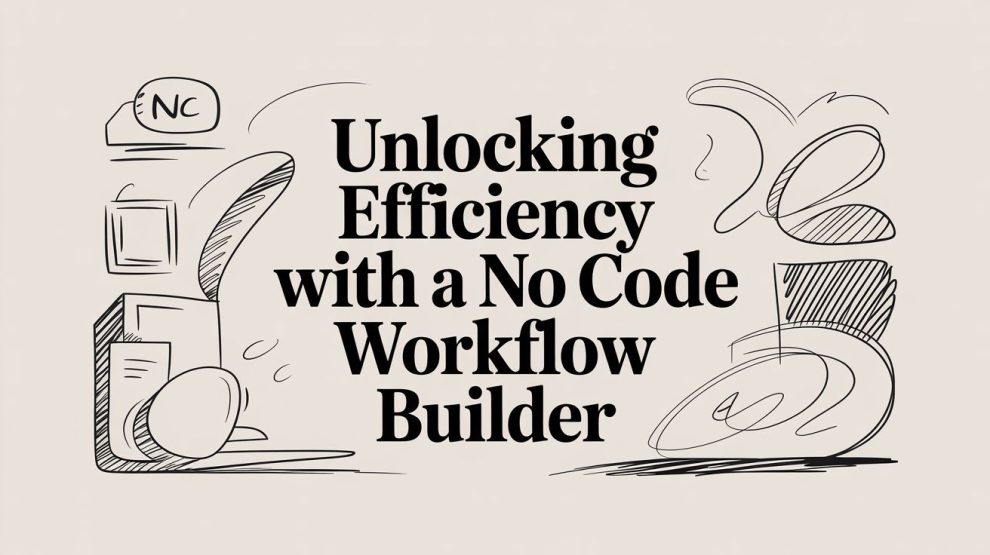

Imagine trying to build something complex, like a custom piece of furniture, but instead of needing a workshop full of tools and years of carpentry experience, you just have a set of high-quality, pre-built pieces that snap together. That, in a nutshell, is what a no code workflow builder does for your business processes.
These tools are all about giving you the power to design, automate, and improve how your business operates, without ever needing to touch a line of code.
What Is a No Code Workflow Builder?

Think of a no-code workflow builder as the command center for your business operations. It’s a visual tool where you can map out a process—like onboarding a new client or approving an invoice—by dragging and dropping blocks that represent different tasks and connecting them.
Instead of asking a developer to write a custom script to connect your CRM to your email marketing tool, you can do it yourself. A marketing manager can build a sophisticated lead nurturing sequence, or an HR leader can automate the entire employee onboarding checklist. The real magic is that it puts the power to build solutions into the hands of the people who know the problems inside and out.
The Shift from Code to Visuals
This move away from code-heavy development has completely changed the game. It’s given rise to a new role: the "citizen developer." These are the business experts on the front lines—the project managers, marketers, and operations specialists—who can now build the exact tools they need.
And this isn't just a small trend. The no-code market is booming, projected to reach $21.2 billion by the end of 2024. That’s after growing at a compound annual rate of 28.1% since 2020. This explosive growth shows just how many businesses are tired of waiting in line for IT and are taking matters into their own hands. For more on this trend, Appstylo offers some great insights on the rapid growth of no-code adoption.
The core value of a no code workflow builder is simple: it puts the power of automation directly into the hands of business users, turning complex operational needs into simple, visual solutions.
Breaking Down the Development Paradigm
To really grasp the difference, let’s compare the old way of doing things with the new. Traditionally, building any kind of internal software was a long, expensive process that required a team of engineers to translate business needs into code. No-code platforms offer a much faster, more direct route.
Now, while these tools are built for non-coders, it helps to know how they differ from their slightly more technical cousins. You can explore the differences between low-code and no-code approaches in our detailed comparison guide.
To see this in action, the table below breaks down the key distinctions.
Traditional vs. No-Code Workflow Development
| Aspect | Traditional Development | No Code Workflow Builder |
|---|---|---|
| Primary User | Professional Developers | Business Users, Department Heads |
| Required Skillset | Coding (Python, Java, etc.) | Logic, Process Knowledge |
| Development Speed | Weeks or Months | Hours or Days |
| Cost | High (Developer Salaries) | Low (SaaS Subscription) |
| Flexibility | High (but rigid once built) | High (easily modified and updated) |
| Maintenance | Requires IT involvement | Managed by business users |
This shift is about more than just speed and cost savings. When you empower your team to solve their own problems, you create a culture of ownership and innovation that spreads through every part of the organization.
What a Modern Workflow Builder Actually Does

It’s one thing to talk about giving everyone the power to automate, but what features make that happen? When you get hands-on with a no-code workflow builder, you'll find it’s not just a simple connector tool—it’s a complete environment for building out business logic visually. Understanding these core pieces is key to picking the right platform.
The foundation of almost every no-code tool is its drag-and-drop interface. This is your digital whiteboard, where you map out your process. Instead of writing lines of code, you grab pre-built blocks that stand for different actions, triggers, and decisions, arranging them into a clear flowchart. This turns an abstract idea into something tangible you can see and follow.
What’s great about this visual method is that it’s not just for making things simpler. It also becomes a form of living documentation. Anyone, from marketing to finance, can look at a workflow and get the gist of how it works, breaking down barriers between technical and non-technical teams.
Conditional Logic: The Brains of the Operation
Just connecting a few apps together is a start, but real automation needs to think and react. That’s the job of conditional logic. It’s the "if this happens, then do that" intelligence that lets your automations make decisions on the fly.
Think of it as setting ground rules for your process. For example, you could build an invoice approval workflow that uses conditional logic like this:
- If an invoice is under $500, approve it automatically.
- If an invoice is over $500, route it to a manager for a second look.
- If the invoice is from a specific vendor, send it straight to the marketing budget owner.
This is what stops you from being stuck with rigid, one-size-fits-all automations. You can create flexible, smart workflows that handle different situations on their own, which means far less manual babysitting and fewer exceptions to deal with.
Jumpstarting Your Workflows with Templates
Staring at a blank screen can be a bit daunting. That's why most platforms come with a library of pre-built templates for common business tasks. These are essentially ready-to-go workflows for things like lead nurturing, new employee onboarding, or routing customer support tickets.
Templates are a huge help in two ways. First, they drastically cut down your setup time. Instead of building from the ground up, you can grab a proven workflow and tweak it to fit your company’s exact process in minutes. Second, they’re fantastic learning tools, showing you the best ways to structure different kinds of automations.
The most powerful feature of any no-code workflow builder is its ability to create a connected ecosystem. It acts as the central hub where all your disparate software tools can finally communicate and work together as a single, unified system.
Integrations: The Secret to True Connectivity
The real magic of a modern no-code workflow builder is its integrations. These are the pre-built connections that let your platform talk to all the other software you rely on every day—your CRM, project management software, communication apps, and everything in between.
Without these connections, your automations would be trapped in a silo. With them, you can build incredibly powerful workflows that span entire departments. For instance, a new sale in Salesforce could instantly trigger a new project in Asana, post a celebratory message in a Slack channel, and add the new customer to a welcome sequence in Mailchimp. Every step happens on its own, with zero manual data entry. You can find comprehensive details on the best workflow automation software available in our updated guide.
This kind of connectivity is what's driving major operational shifts. The workflow automation market was valued at $20.3 billion in 2023 and is projected to climb to $46.8 billion by 2032. With such massive adoption—over 80% of users are on no-code tools at least weekly—these platforms are constantly evolving. For a closer look at the data behind the movement, you can explore detailed no-code statistics and user engagement data.
How Departments Transform Operations with No-Code
Theory is one thing, but the real power of a no-code workflow builder clicks when you see it solve actual, day-to-day business problems. So, let's move past the concepts and look at how these tools are fundamentally changing the way teams operate.
We’ll walk through three common scenarios—in HR, Marketing, and Finance. Each story starts with a familiar headache, followed by a practical no-code solution and the very real results it delivered.
HR Streamlines New Hire Onboarding
The Problem: Picture a growing tech company where the HR team was constantly playing catch-up. Their new hire onboarding was a mess of spreadsheets, email chains, and sticky notes. Critical steps got missed, IT didn't get timely requests for new accounts, and new hires often felt completely adrift in their first week. It was a terrible first impression that wasted everyone's time.
The No-Code Solution: Instead of hiring another coordinator, the HR manager mapped out their ideal onboarding process using a no-code builder. Now, the entire sequence kicks off automatically the moment a candidate signs their offer letter in an e-signature platform.
This single trigger sets off a chain reaction:
- A ticket is instantly created for the IT team, complete with the new hire’s details, to get their laptop and software ready.
- The new employee is automatically added to the core HR and payroll systems.
- A friendly welcome email is scheduled for their first morning, outlining the week's agenda and providing key contacts.
- The hiring manager gets a ping with their own checklist, reminding them to do things like schedule a team welcome lunch.
The Impact: The result? Manual errors vanished, and every new employee now gets a consistent, professional welcome. The HR team estimates they save 8-10 hours of admin work per new hire. More importantly, feedback from new employees showed a 40% jump in satisfaction with their onboarding experience.
Marketing Puts Lead Nurturing on Autopilot
The Problem: The marketing team was doing a great job bringing in leads from their website, but they had a leaking bucket. With a small team, they simply couldn't follow up with every single person who downloaded an ebook or attended a webinar. Promising opportunities were going cold from a simple lack of timely, personal communication.
The No-Code Solution: The marketing specialist used their no-code tool to build a lead nurturing machine. As soon as a new lead hits their CRM, a workflow springs into action.
By connecting their existing tools, the marketing team created an automated communication engine that works 24/7, ensuring no lead is ever forgotten.
The automation isn't just a simple email blast; it uses conditional logic to send the right message at the right time:
- If a lead signed up for a webinar, they get a series of emails with related content and an invitation to book a demo.
- If they downloaded an ebook on a specific feature, the system sends them a case study showing that exact feature in action.
- Any lead who clicks on a pricing page link is automatically flagged as "high-intent," and a task is created for a sales rep to call them personally.
The Impact: Just two months after going live, the team saw a 30% increase in lead-to-opportunity conversion rates. Sales reps started having better conversations because leads were already educated and engaged before a human ever got involved.
Finance Eliminates Invoice Approval Bottlenecks
The Problem: For the finance department, invoice approvals were a painful, manual slog. Invoices would arrive in someone's inbox, get printed out, and then hand-carried around the office for signatures. It was a recipe for lost paperwork, late payment fees, and strained vendor relationships.
The No-Code Solution: The finance controller designed a brilliantly simple workflow to fix the bottleneck. Now, employees submit all invoices through a digital form, which kicks off the automated approval process.
The workflow intelligently routes the invoice based on its details. For instance, a $200 marketing invoice goes straight to the Marketing Manager via Slack for a quick one-click approval. A larger $10,000 engineering invoice, however, is routed first to the department head and then to the VP of Finance for a second sign-off. Once fully approved, the system notifies accounting to pay the bill and archives the invoice automatically.
The Impact: The new process slashed the average invoice approval time from seven days to just 24 hours. Late payment fees became a thing of the past, saving the company thousands each quarter. Best of all, the finance team reclaimed over 15 hours per week that they used to spend just chasing down signatures.
How to Choose the Right No-Code Platform
With so many no-code workflow builders on the market, picking the right one can feel like a shot in the dark. It's easy to get distracted by flashy marketing, but long-term success comes down to a few core fundamentals. A platform might look great in a demo, but if it’s clunky to use or can't grow with you, it will end up collecting dust.
Think of this less as a simple purchase and more as a strategic partnership. The right tool will empower your team for years to come, while the wrong one leads to frustrated users, a wasted budget, and an automation strategy that never gets off the ground.
Start with User Experience and Ease of Use
The whole point of no-code is to make automation accessible to everyone, not just developers. If your non-technical employees can't get the hang of a platform quickly, it has failed its most basic test. The interface needs to feel clean, logical, and intuitive from the moment you log in.
Look for a smooth drag-and-drop builder, clear labels, and helpful tutorials that guide you along. A tool with a steep learning curve will kill adoption before it even starts. The best test? Have one of your team members try to build a simple two-step workflow with almost no instructions. If they can do it, you're on the right track.
Evaluate Scalability and Performance
Your business is going to grow, and so will your need for automation. The platform you choose today must be able to keep up with tomorrow's demands. This isn't just about adding more users; it's about handling more data, running more complex workflows, and doing it all without slowing down.
When you're talking to vendors, get specific about their architecture:
- Execution Limits: Are there monthly caps on how many workflows can run or how many tasks can be processed?
- Performance Under Load: What happens when hundreds of automations are triggered at once?
- Complexity Handling: Can the platform manage workflows with dozens of steps and complicated conditional logic?
A platform that works perfectly for a five-person team might completely buckle under the demands of a 50-person department. Always plan for where you're going, not just where you are.
This decision tree shows how different departments—like HR, Marketing, and Finance—can map their unique problems to specific no-code solutions.

Use this as a guide to focus on the features that will solve your most critical business bottlenecks, ensuring you don't pay for a tool that's a poor fit for your main use case.
Scrutinize Security and Compliance
When you start automating processes, you're giving a third-party platform the keys to your sensitive business and customer data. Security is not an area where you can afford to cut corners. The tool you choose must have enterprise-grade security to protect your information and help you stay compliant with regulations.
Look for key security certifications like SOC 2 Type II, which signals a serious commitment to secure data handling. Beyond that, make sure the platform provides essential security features out of the box:
- Data Encryption: For data both in transit (moving between systems) and at rest (stored on servers).
- Role-Based Access Control (RBAC): Gives you granular control over who can see, create, and edit workflows.
- Audit Logs: Provides a clear, unchangeable record of all user activity for accountability.
Failing to properly vet a platform's security posture can expose your business to serious financial and reputational risk. If you're also planning to build customer-facing tools, many of these same security principles apply, as we cover in our guide to choosing a no-code web app builder.
Assess the Integration Library
A workflow builder's true power lies in its ability to connect all the different apps you use. It should act as the central hub that gets your entire software stack talking to each other. Before you even think about signing a contract, you need to dig into the platform's list of integrations.
Make a list of your must-have tools—your CRM (Salesforce, HubSpot), your project management software (Asana, Jira), your cloud storage, and your team chat app. Does the platform have reliable, pre-built connections for them? A deep integration library saves you from needing developers to write custom code. If a key app is missing, check if the platform has a flexible REST API connector or supports webhooks to build your own connections.
No-Code Workflow Builder Evaluation Checklist
Choosing a platform is a major decision, and it helps to have a structured way to compare your options. Use this checklist during demos and trial periods to score each platform against the criteria that matter most to your business.
| Evaluation Criteria | What to Look For | Your Notes |
|---|---|---|
| User Interface & Ease of Use | Intuitive drag-and-drop builder, clear navigation, helpful in-app guides. Can a non-technical user build a simple workflow in under 15 minutes? | |
| Integration Library | Native integrations for your core business apps (CRM, ERP, PM tools). Availability of a universal API connector or webhooks for custom connections. | |
| Scalability & Performance | Clear and generous limits on workflow runs and tasks. Documentation or case studies on performance under heavy load. | |
| Security & Compliance | SOC 2 Type II or ISO 27001 certification. Features like Role-Based Access Control (RBAC), SSO, and detailed audit logs. | |
| Error Handling & Debugging | Visual logs of workflow runs. Clear error messages and easy-to-use tools for identifying and fixing broken steps. | |
| Pricing & Value | Transparent pricing that scales logically with usage. Avoids "gotcha" fees for premium features. Does the cost align with the expected ROI? | |
| Support & Community | Access to responsive technical support (chat, email, phone). Active user community, forums, and extensive documentation. |
By systematically walking through these points, you can move past the sales pitches and make an informed decision based on how well the tool actually meets your operational needs. This deliberate approach ensures you end up with a platform that your team will love and that will deliver real value for years to come.
Your Implementation Roadmap for Success

Bringing a new tool into your business is one thing; getting people to actually use it is another challenge entirely. Success with a no-code workflow builder isn't just about the technology—it’s about people. You need a smart plan to build excitement and prove the tool's value from day one.
The best way to do this is with a classic "crawl-walk-run" approach. It’s a strategy that lets you build momentum, sidestep common roadblocks, and turn early curiosity into genuine enthusiasm across your entire company.
Phase 1: Crawl with a High-Impact Pilot Project
The biggest mistake teams make is trying to do too much, too soon. Don't start by trying to automate a massive, complex process. Instead, your first move should be to score a quick, visible win.
Find a small, well-understood problem that’s a constant source of frustration for a single team. Think about those manual, repetitive tasks that everyone complains about but are not necessarily business-critical. Things like managing vacation requests, routing simple IT support tickets, or chasing down approvals for marketing content are perfect candidates.
- Pinpoint Your Goal: Be specific about what you want to achieve. For instance, "We want to cut the approval time for a new marketing asset from three days down to just four hours."
- Keep the Scope Narrow: Stick to one department and just a handful of users for your pilot. This makes it incredibly easy to gather honest feedback and make changes on the fly.
- Measure What Matters: Track everything—hours saved, mistakes eliminated, even just a simple poll on team satisfaction. This data becomes your strongest evidence when you're ready to expand.
The whole point of a pilot isn't just to test the software. It's to create a compelling success story that you can tell over and over again.
When your colleagues in accounting see the marketing team solve a nagging problem in a single afternoon, they’ll be knocking on your door to ask how they can do the same. That's how you build real momentum.
Phase 2: Walk by Empowering Your Champions
Once you have that first win, look for the enthusiastic, tech-curious people from your pilot group who "get it." These are your future citizen developers—the internal champions who see the potential and are eager to learn more.
Give these champions some extra training and the green light to tackle slightly bigger challenges in their own departments. As more people start building, it's the right time to introduce some simple ground rules. We’re not talking about a hundred-page rulebook, just some basic guidelines to keep things organized.
Simple Governance Rules to Start:
- Workflow Naming: Use a consistent naming convention so everyone can find what they're looking for (e.g.,
MKTG - New Lead Follow-Up). - Testing First: Make it a rule that all new workflows must be tested in a safe "sandbox" environment before they go live.
- Clear Ownership: Every workflow needs a designated owner and a quick note explaining what it does.
These simple guardrails prevent chaos without killing the creative spark that no-code is all about.
Phase 3: Run by Scaling Your Success
With a few wins and a group of excited champions, you're ready to go big. Use the data and the success stories you've collected to show other department heads what’s possible. Now, you’re moving from fixing isolated problems to building a truly connected and efficient organization.
This is where you’ll start seeing the kind of results driving the massive growth in no-code, especially for small and midsize businesses (which make up over 60% of the market). Companies are jumping on board because they’re seeing up to 70% cost savings and launching new projects 45% faster. With top platforms boasting a 70% satisfaction rate, it’s clear why so many businesses are making no-code a core part of their strategy. You can see more statistics on the rapid adoption and impact of no-code platforms.
By following this roadmap, you're not just rolling out software. You're systematically changing how your company works for the better, one automated workflow at a time.
Common Questions About No Code Workflow Builders
It's completely normal to have a few nagging questions before you dive into a no code workflow builder. After all, you’re talking about tools that will become a core part of how your business runs.
Let's tackle some of the biggest concerns we hear from teams just like yours, so you can move forward with total confidence.
How Secure Are These Platforms?
This is usually the first question, and for good reason. You're connecting your business-critical apps and trusting a platform with sensitive data. Any provider worth its salt knows this and builds its platform with enterprise-grade security as a foundation, not an afterthought.
The best platforms prove it by achieving SOC 2 compliance, which is a rigorous, independent audit of their data management and protection practices. Look for essential security features like:
- End-to-end data encryption, which protects your information whether it’s being sent between apps or sitting in the platform.
- Granular user permissions that let you control exactly who can see, build, or change specific workflows. This ensures employees only have access to what they need for their roles.
These aren't just nice-to-haves; they are absolute musts for any serious no code workflow builder.
Can a No Code Platform Really Scale?
The fear that a tool will buckle under pressure as your company grows is a valid one. You don't want to build a bunch of automated processes only to have to rip them out and start over in a year.
Thankfully, modern no-code platforms are built for this very challenge. Most run on cloud-native architectures, meaning they're designed from the ground up to handle massive increases in data volume and user activity without skipping a beat.
Think of it like this: a well-built no-code platform doesn't just work for your five-person team today. It's engineered to support your 500-person company tomorrow, managing thousands of automated tasks without breaking a sweat.
This built-in scalability means the workflows you create today are a sound long-term investment, ready to grow right alongside your business.
What Is the Difference Between No Code and Low Code?
You'll often hear "no-code" and "low-code" mentioned in the same breath, but they're aimed at two very different groups of people. The distinction is simple but crucial.
A no code workflow builder is made for business experts—the people in marketing, HR, finance, and operations who know their processes inside and out but have zero interest in learning to code. Everything is done through a visual, drag-and-drop interface.
Low-code platforms, on the other hand, are for developers. They also offer visual tools to speed things up, but they open the door for developers to write custom code for more complex integrations, unique features, or connections to old-school legacy systems. It's a powerful middle ground designed to make developers more efficient.
Ready to see how a no-code approach can transform your business? Explore the extensive guides, comparisons, and expert insights at Low-Code/No-Code Solutions. Discover the right tools to automate your processes and drive growth. Find out more at https://lowcodenocodetool.com.



Add Comment